To Kill a Mockingbird and After School Blueberry Lemon Cookie

Every year I try to read something for banned book week. Most years I fail. I’m a planner in most aspects of life, just not in my reading habits. However I’m in multiple book clubs now, and also help to create some social media content for my work’s accounts, so Banned Books Week was actually on my radar a month earlier than normal. 

Which meant I was able to snag the audiobook of To Kill a Mockingbird from my public library before anyone else could jump on the Banned Book bandwagon. 

First off, yes I think audiobooks count as reading. Thank you. 

Second. Wow. I didn’t know it was possible to fall in love with a story you already knew so strongly. 

I first read To Kill a Mockingbird my first semester of high school. I was young and naive. I didn’t know what books I liked. I didn’t understand what made a classic a classic. I knew I enjoyed Scout and Jem. I knew Atticus was a good man. It felt like the right type of story to be reading. Realistically I didn’t understand more about race and fairness than Scout. I still loved the book. I enjoyed the movie too. I was officially a Harper Lee fan.

And then I ignored her and mockingbird for 15 years. When Go Set a Watchman came out I read the coverage and decided to skip reading, for reasons I outlined in my actual review of Watchman last week. I probably sent out a sad tweet when Lee died, but that would have been the extent of my interactions.

Then Furious Hours came out this year and I was obsessed again. I didn’t remember as much from Mockingbird as I had originally thought. I gained a better understanding of Harper Lee’s life, the more autobiographical nature of parts of her work, and the place Watchman fits in everything. I also knew I wanted to give her seminal work another try. 

Reading To Kill a Mockingbird at 30 was like coming home. The whole gang was there. Only now I had background information. Dill was clearly based on Truman Capote, which is a sentence 14 year old me wouldn’t even know how to process. Scout is also younger than I remembered, and her naivete shows. The fact that it was only published in 1960 really packs the biggest punch. Civil rights were still a hot button issue. Writing something from a southern perspective set during the 30’s was a hot take. 

Mockingbird carries more weight because of its setting and time. It also carries more weight coming from a true Alabamian. 

More than anything though Mockingbird is a tale of growing up, of learning that life isn’t always fair, and that you shouldn’t always judge a book, or a person, by their exterior. 

To Kill a Mockingbird also reminded me of my own school days, coming home for a homemade snack, talking with my mom and spending time with my friends. It reminded me of cookies. So while I was listening to Sissy Spacek narrate Scouts coming of age story I popped into the kitchen and made up a snack of my own. 

These cookies are a little cakey, a lot of blueberry, and have the most perfect lemon glaze. They’re soft and moist and a pop of flavor. They’re everything a picky eater would ignore, but we are adults now, and no longer picky eaters. 

Ingredients

1 c flour

½ c softened butter

4 oz cream cheese

1 egg

1 tsp vanilla

2 ½ c flour

1 tsp baking soda

1 tsp baking powder

¼ tsp salt

2 c blueberries (about a quart) 

1 ½ c powdered sugar

1 tbsp lemon juice, fresh

1 tbsp milk

1 tsp vanilla

Zest of 1 lemon

Preheat oven to 350. Line a baking sheet with parchment paper. 

Cream together butter, busar, and cream cheese. Add egg and vanilla until combined. 

In a second bowl combine flour, baking soda, baking powder and salt and then mix into wet. 

Gently fold in blueberries. Be careful not to burst the berries as they will dye your batter.

By the rounded tablespoon place cookies on prepared baking sheet. Bake for 12 to 14 minutes. 

For glaze, whisk together powdered sugar, lemon juice, milk, vanilla and lemon zest. Wait for cookies to cool. Drizzle with glaze. Enjoy!
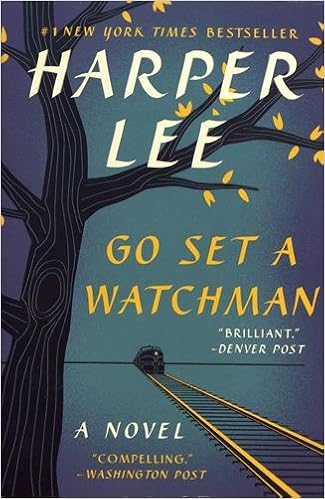
Review: Go Set a Watchman by Harper Lee

I read To Kill a Mockingbird when I was 14. It was the first classic I loved. 

So of course in 2015 I was both a little shocked and very weary of Go Set a Watchman. It seemed to be published against Lee’s wishes. I couldn’t tell if it was actually a new story. I heart awful things about All Time Literary Great Atticus Finch. I opted to ignore Watchmen’s existence and I was happy. 

This year for Banned Book Week I reread Mockingbird. I had forgotten how intricate and great it truly was. I would muse more but I promise more Mockingbird Love for you later this week.  Anyway, when I finished Mockingbird I got back to thinking about Watchman. After reading Furious Hours this year I felt I knew a bit more about the circumstances of it’s original creation. I felt more knowledgeable about Harper Lee. I felt like I could actually read it. 

A few things before I get to the actual review. Go Set a Watchman was at first billed as a sequel to the beloved To Kill a Mockingbird. It is now widely accepted that this is not the case. Instead, Watchmen is the first draft of Mockingbird. There are full segments that appear in both works. Scout flashes back to memories of her childhood that we live fully in Mockingbird. Mostly, it is obvious to see ho Lee’s editor saw promise in those flashbacks, and asked for another draft of Watchment from that point of view. 

In Go Set a Watchman Jean Louise (Scout, who is rarely called Scout)  is heading home for her yearly two weeks in Macomb, Alabama. On this trip she discovers that while she has always been different from her southern neighbors, she never realized how different her views were in the Jim Crow South. Over her vacation she spends time with her childhood sweetheart, her old housekeeper, her aunt, uncle, and of course Mr. Atticus Finch. 

Watchmen has it’s redeeming qualities. Jean Louise feels exactly like Scout having grown up. Her unease and struggle at understanding the home she loved and willingly returned to plays as real. She has always been a headstrong character. She doesn’t compromise. She yearns to understand. Only now she is an adult, and Brown V Board is law, and Macomb is a little more racist than she remembers. 

Overall I have mixed feelings. If this were published in Mockingbird’s place we would not nationally know Harper Lee. Watchmen would  have read as much more controversial. I am most impressed with Lee’s reflection on sensitive racial topics in her beloved Alabama in 1957. While this does a bit to diminish Mockingbird’s legacy, I think there is some real wisdom to be gained, and a few really powerful nuggets still relevant today. 

The general message behind Watchmen seems not to be Surprised! Atticus Finch is a racist asshole! It is that looking at motivation and reason are important when reading into someone’s beliefs. Now a quick disclaimer, since this is an entire book about the Jim Crow south looking into those motivations is sketchy. They are all racially tinged. It reads as true for it’s time but not as a get out of jail free card in 2019. 

However, we live in an America currently deeply divided by politics. My family doesn’t agree on much anymore. A lot of Jean Louise’s conversations with her uncle about perspective and motive made me think of conversations with my own family recently, not about race, but about our president. Somehow Watchmen started to feel contemporary. The United States still refuses to deal with it’s dark racial legacy and bigotry runs rampant in our economy and government. What’s so different from 1957?

I will say that all of the complaints I heard about Watchmen hold true. It feels like a draft. The writing isn’t as crisp as it eventually appears in Mockingbird. Without the childhood perspective and innocence the subject  matter feels heavy. Atticus is not the white knight we grew up loving. He was not Gregory Peck in a courtroom, about to win an Oscar. He is old and frail. Jean Louise/Scout sees him through adult eyes. He isn’t the hero we deserve anymore. 

And truly that is the biggest loss. 

Really, Go Set a Watchmen isn’t bad. It is easy to see why Lee held this work close to her chest for almost her entire life. She was a perfectionist and this novel isn’t perfect. It has enjoyable moments and cloying moments. The flashback to the Finch children’s childhood sing, just like all of Mockingbird. However, Macomb in the 1950’s isn’t a fun place to be, and the residence want you to know you aren’t welcome.